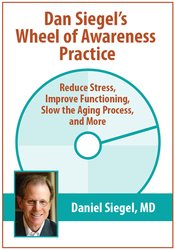
Dan Siegel’s Wheel of Awareness Practice: Reduce Stress, Improve Functioning, Slow the Aging Process, and More
- Speaker:
- Daniel Siegel, MD
- Duration:
- 5 Hours 38 Minutes
- Format:
- Audio and Video
- Copyright:
-
Mar 23, 2019
- Product Code:
- NOS096030
- Media Type:
- Digital Seminar

Description
In this workshop recording, interpersonal neurobiology expert Daniel Siegel will explore how advances across a range of disciplines—including brain science, psychiatry, attachment theory, quantum physics, and spirituality, to name just a few—have expanded our conception of consciousness, and what this means for the practice of psychotherapy.
Then he’ll guide you through his revolutionary Wheel of Awareness exercise. The Wheel can be used to reduce stress, improve cardiovascular and immune system functioning, and slow the aging process. It incorporates the three pillars of mental training: focused attention, open awareness, and kind intention. This session will demonstrate how to incorporate it into therapy to cultivate more meaning and connection in clients’ lives.
Credit
Speaker
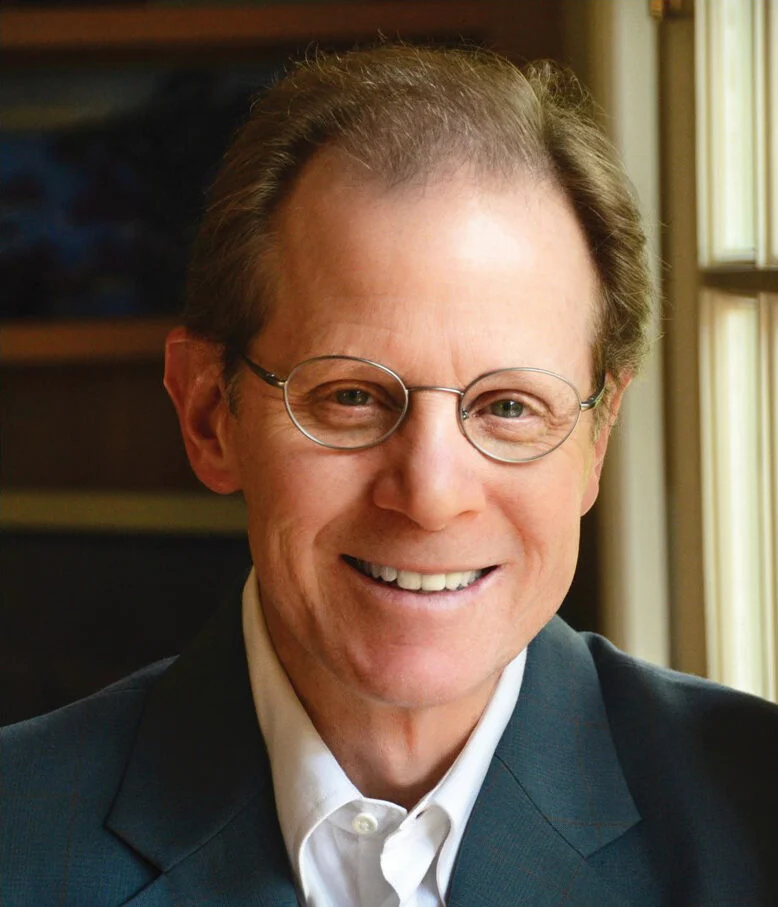
Daniel Siegel, MD Related seminars and products
Mindsight Institute
Dr. Dan Siegel is the founder and director of education of the Mindsight Institute and founding co-director of the Mindful Awareness Research Center at UCLA, where he was also co-principal investigator of the Center for Culture, Brain and Development and clinical professor of psychiatry at The School of Medicine.
An award-winning educator, Dan is the author of five New York Times bestsellers and over fifteen other books which have been translated into over forty languages. As the founding editor of the Norton Professional Series on Interpersonal Neurobiology (“IPNB”), Dan has overseen the publication of over one hundred books in the transdisciplinary IPNB frame which focuses on the mind and mental health.
A graduate of Harvard Medical School, Dan completed his postgraduate training at UCLA specializing in pediatrics, and adult, adolescent, and child psychiatry. He was trained in attachment research and narrative analysis through a National Institute of Mental Health research training fellowship focusing on how relationships shape our autobiographical ways of making sense of our lives and influence our development across the lifespan.
Speaker Disclosures
Financial: Dr. Dan Siegel serves as the Medical Director at the Lifespan Learning Institute and is the Co-Founder and Director of Education at the Mindsight Institute. He is also the founding editor of the Norton Series on Interpersonal Neurobiology. Dr. Siegel receives royalties as a published author and serves as a scientific advisor for the Inner Development Goals initiative and as an advisor for the Center for Child Well-Being. Additionally, he receives honoraria and recording royalties from Psychotherapy Networker and PESI, Inc. Dr. Siegel has no relevant financial relationships with ineligible organizations.
Non-financial: Dr. Dan Siegel is an honorary member of the Austrian Federal Association for Mindfulness. He also serves on the Board of the Garrison Institute and as an advisory board member for both Gloo and Convergence.
Additional Info
Program Information
Access for Self-Study (Non-Interactive)Access never expires for this product.
Questions?
Visit our FAQ page at https://mindsightinstitute.com/support or contact us at https://mindsightinstitute.com/contact-us/.
Objectives
- Explore how advances across a range of disciplines---including brain science, psychiatry, attachment theory, quantum physics, and spirituality, to name just a few---have expanded our conception of consciousness, and what this means for the practice of psychotherapy.
- Discover the role of “conscious awareness” in the process of psychotherapy and how therapists can guide that experience to help clients feel connected to others.
- Explain the results of a systematic study of the Wheel of Awareness involving thousands of individuals and how what it can tell us about how to help clients bring more awareness into the process of change.
- Describe the four parts of the Wheel and how to use them in therapy to improve clinical outcomes.
- Recognize the systemic principles of chaos and rigidity and how they can help us better grasp our clients’ issues and guide them toward learning to savor the experience of life in a more balanced and fulfilling way.
- Apply the Wheel in sessions to reduce clients’ stress and improve cardiovascular and immune system functioning.
- Understand the role attachment play in affect regulation and how therapy can correct dysregulation.
Outline
Consciousness and Connection in Psychotherapy
The present state of humans on earth
- Less than collaborative
- The role of mental health in important world issues.
- Consilience
- Ways to get involved in world change
- Changing social systems.
- Health benefits
- What is energy?
How change occurs
Understanding the interconnection of all people
The Wheel of Awareness
- Mind as an emergent aspect of embodied and relational energy flow
- Integration as the optimization of the self-organizing aspect of the mind
- Integrating Consciousness with the Wheel of Awareness
Discussion and Reflection
- Reflecting on the Wheel as a first-person immersion, and the Ten-Thousand Person Study
- Linking Subjectivity, Science, and Spirituality
- Learning, Living, and Loving from the Plane of Possibility
- Synthesis, Discussion, and Integration
Target Audience
- Psychologists
- Physicians
- Addiction Counselors
- Counselors
- Social Workers
- Marriage & Family Therapists
- Nurses
- Other Behavioral Health Professionals.
Reviews
| 5 |
|
| 4 |
|
| 3 |
|
| 2 |
|
| 1 |
|
Overall: 4.7
Total Reviews: 166
Satisfaction Guarantee
Your satisfaction is our goal and our guarantee. Concerns should be addressed to info@mindsightinstitute.com.
Please wait ...