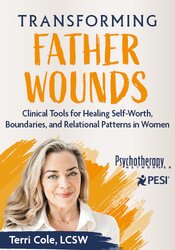
Transforming Father Wounds
Clinical Tools for Healing Self-Worth, Boundaries, and Relational Patterns in Women
- Speaker:
- Terri Cole, LCSW
- Duration:
- 3 Hours
- Format:
- Audio and Video
- Copyright:
-
Oct 30, 2026
- Product Code:
- NOS096776
- Media Type:
- Digital Seminar

Description
In our clinical work with female clients, a familiar pattern often emerges: women may come in for help with anxiety, relationship struggles, burnout, perfectionism, or a vague sense that something is off, and the original injury underneath those presentations can go unnamed. When we don't identify the original injury, we risk treating the symptoms while the wound continues to drive the behavior.
For many women, the original injury is a father wound, an attachment injury rooted in the father-daughter relationship and reinforced by patriarchal culture. Some experienced overt abuse, abandonment, addiction, or neglect. Others grew up with fathers who were loving but limited, present but emotionally absent, or "good enough" in ways that still left subtle injuries.
In this three-hour workshop, you'll explore a clinically grounded approach to recognizing and addressing father wounds as a form of attachment injury and ongoing relational trauma, affecting the nervous system, attachment, and self-worth.
You'll discover practical interventions that help clients move from unconscious adaptation and self-abandonment to self-trust, regulation, and conscious relational choice. Because this is the client's healing work, it does not require the father's participation, presence, or permission. You'll learn how to help clients:
- Recognize father wounds in their many forms, including in clients who don't "look wounded"
- Name how these wounds extend beyond romance into work, money, motherhood, friendship, and the self-relationship
- Mourn what was missing without collapsing into blame, rumination, or fixation on the father
- Address the role of maternal co-wounding and how it amplifies or buffers the original wound
- Identify the adaptive responses, including people-pleasing, over-functioning, hyper-independence, avoidance, or emotional shutdown, that kept them safe as children but stuck as adults
- Build boundaries, self-trust, and self-consideration as the foundation of healing
- Reclaim joy, pleasure, and sovereignty as part of the healing arc, not the reward at the end
Credit
Speaker

Terri Cole, LCSW Related seminars and products
Terri Cole, MSW, LCSW, is a licensed psychotherapist and the author of Boundary Boss and Too Much! For over two decades, Terri has worked with a diverse group of clients that includes everyone from stay-at-home moms to celebrities and Fortune 500 CEOs. She reaches over a million people weekly through her blog, social media platform, courses, and podcast, The Terri Cole Show.
Speaker Disclosures:
Financial: Terri Cole maintains a private practice and receives compensation as a online course instructor. She is a podcast host of The Terri Cole Show. Terri Cole receives royalties as a published author. She has no relevant financial relationships with ineligible organizations.
Non-financial: Terri Cole is a member of the National Association of Social Workers. She is a contributing author and presenter with Psychotherapy Networker.
Additional Info
Program Information
Access for Self-Study (Non-Interactive)Access never expires for this product.
For a more detailed outline that includes times or durations of time, if needed, please contact cepesi@pesi.com.
Questions?
Visit our FAQ page at www.pesi.com/faq or contact us at www.pesi.com/info
Objectives
- Identify clinical presentations of father wounds in adult female clients, including subtle, overt, and easily missed manifestations across the spectrum of presentation.
- Examine how father wounds function as a form of attachment wounding and ongoing relational trauma, affecting the nervous system, attachment patterns, and self-worth.
- Apply interventions that help clients mourn what was missing and reduce self-abandonment behaviors rooted in early paternal injury.
- Implement somatic, cognitive, and relational strategies that support self-trust, healthier boundaries, reclaimed joy and sovereignty, and conscious relational choices.
Outline
Identifying and Understanding the Father Wound
- Define the father wound: Why so many clients don't recognize it in themselves
- Recognize the range of presentations: From overt absence or abuse to subtle emotional unavailability
- Spot how the wound shows up throughout relationships, career, and self-perception
- Use the Father Wound Blueprint to map each client's unique unconscious patterns
Root Causes and Relationship Patterns
- Recognize family dynamics and early survival strategies that created the wound
- Identify how patriarchal culture reinforces and normalizes father wounding
- Assess attachment styles shaped by the father-daughter relationship
- Explore how maternal co-wounding amplifies or buffers the wound
The Hidden Costs of an Unhealed Father Wound
- Identify and understand how unhealed father wounds drive chronic self-abandonment
- Assess the personal costs: Self-doubt, people-pleasing, and disordered boundaries
- Identify the False Self adaptations clients built to survive and how they now limit them
- Identify crisis moments and stuck points that can become breakthrough opportunities
- Limitations of the research and potential risks
Recovery Tools and New Ways of Healing
- Apply the Identify, Acknowledge, Honor, Integrate framework for father wound healing
- Build emotional resilience: help clients recognize triggers and regulate responses
- Introduce self-parenting practices that give clients the presence they didn't receive
- Teach boundary-building skills that support internal safety
- Help clients grieve what was missing without getting stuck in blame or fixation on the father
- Reframe forgiveness as something the client does for herself not for him
Target Audience
- Counselors
- Social Workers
- Marriage & Family Therapists
- Psychologists
- Psychiatrists
- Psychotherapists
- Addiction Counselors
- Case Managers
- Other Mental Health Professionals
Reviews
| 5 |
|
| 4 |
|
| 3 |
|
| 2 |
|
| 1 |
|
Overall: 4.8
Total Reviews: 351
Satisfaction Guarantee
Your satisfaction is our goal and our guarantee. Concerns should be addressed to info@mindsightinstitute.com.
Please wait ...